|
|
Ground Hog Day marked the start of the new growing season, but spring began in earnest the second week in March with a flurry of outdoor activity during a welcome thaw.  Maple sap flowed freely in the warm sunshine, the ducks began laying daily eggs, and it was planting time indoors and in the hoop house.
Even after chilly temperatures returned this week, vernal colors remain with over-wintered greens putting out new growth along with daffodils blooming in the hoop house. Â Forsythia branches kept in a vase on the kitchen table popped open their yellow blossoms soon to be followed by soft salmon pink of the flowering quince.
So while winter comes and goes in March and continues into April, gardeners can feed their souls and coax early harvests by steadily exploiting every opportunity to maximize the growing power of spring sunshine. Â Here’s my monthly to-do list of gardening tasks to help you cherish the on-and-off, Northern version of spring.
 Row covers removed from beds in the hoop house on March 16 revealed daffodils in bloom! MARCH
- Set up an indoor seed starting system if you haven’t already, providing supplementary light if possible.
- Start seeds for celeriac, peppers, eggplants, and basil indoors along with any herbs or flowers that need a long season (many people start the latter along with any onion family starts in February)
- Prepare soil under cover (cold frame, hoop house, etc) as soon as ground thaws, in any empty places and seed hardy greens.
- Plant peas and fava beans under cover amongst the overwintered lettuce and spinach, so the new plants can take over as soon as the greens are done.
- Water, weed and harvest under-cover, any over-wintered greens and herbs as they put out new growth.
- Cover a bed or garden area with plastic to melt snow and dry it for early planting.
- Graft and prune fruit trees, shrubs and vines
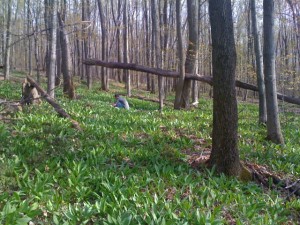 A wonderland of wild leeks where we go to harvest in April. APRIL
- Prepare soil and direct-seed all hardy plants (spinach, lettuce, peas, cabbage family, onion family, carrots, beets, etc.) in garden as soon as soil can be worked.
- Mulch plants that are under cover as temperatures warm to keep roots moist and prevent overheating
- Harvest greens at a steadily increasing rate.
- Remove plants that are under cover as they bolt unless you want them to seed themselves, and plant new crops (potato sets can handle surprisingly cold soils), transitioning to increasingly tender crops as season progresses.
- Start tomato seeds indoors under lights
- Remove mulch from asparagus and rhubarb to warm soil
- Apply compost and mulch to root zone of fruit trees
- Transplant woody plants and perennials if soil is no longer wet
- Harvest dandelion leaves and roots before the plant flowers.
- Head into woods to look for morels and large patches of wild leeks (places where you can harvest sustainably)
 Freshly mulched perennials, bordered by creeping phlox, between showers in May. MAY
- Transplant tomato seedlings and other transplants to larger pots, burying any leggy stems to encourage strong root growth.
- Add good quality compost to all garden beds to improve soil texture, fertility and reduce disease
- If possible, prepare beds for summer plants at least a week or two before you plant.
- Direct seed root crops and hardy greens in early May.
- Direct seed or plant in pots, long-season cabbages and brussels sprouts for winter storage
- Plant potatoes early as well as onion-family plants and sets
- Plant squash, cucumbers and other warmth-loving plants (those with with large seeds) in pots if you want – otherwise wait and plant directly in the soil when it warms.
- Harvest lettuce, greens, radish, chives from earlier plantings and sorrel, rhubarb and asparagus from perennial plantings
- Forage for pheasant back mushrooms young nettles, wild leeks and other spring greens.
- Transplant woody plants and perennials
- Transplant tender plants (tomatoes, peppers, eggplants, basil, squash corn, beans etc.) into ground when soil & air are consistently warm – maybe at the end of May but often best to wait until June. Â Remember the rule of thumb: don’t plant until you can comfortably sit on the soil with a bare bum!
Every season and every garden are unique and every gardener has a different routine so I offer this schedule only as a guide to help you find your own groove. Â Happy Spring!
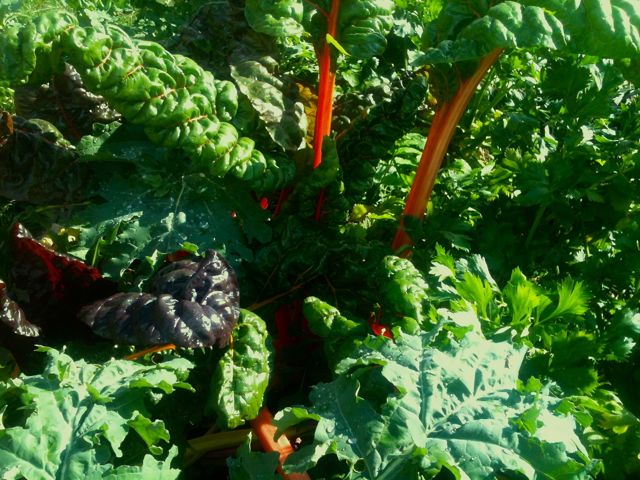
 A riot of autumn greens - chard and kale. Between the withering heat of summer and the icy winds of winter comes the season we normally associate with warm colors – orange, red and gold – and later the browns of stick season. Â But for gardeners, these are the seasons to relish and admire vibrant greens bursting from the ground.
Chard, kale, broccoli, parsley, arugula and other cold-loving greens that start with gusto in the spring then limp through the summer with dull, coarse leaves and not much flavor, suddenly become glossy, vivid, with a tender texture and sweet flavors in the fall. Â Later, as freezing temperatures take their toll, some older leaves may wither but with protection, the inner leaves will often remain intact well into the winter.
The gorgeousness of green leafy vegetables in autumn would be enough to feed my soul but they also bring deeply satisfying flavors to the table that I love and crave. (The craving no doubt a response to the impressive nutritional benefits that greens offer.)  Am I crazy to admit that I actually prefer the greens of spring and fall to the fruits of summer?  This might explain my obsession with season-extending and focus on coaxing harvests during the shoulder seasons – because greens are what grow best when its cold.
Many people believe that kale and other greens are bitter and unpalatable.  This may be partially due to only having access to greens harvested in summer or grown in hot climates.  But there may also be a general gap in knowledge about how to prepare greens to get the best flavor.  Here are some ideas for savoring the green gifts gardens offer in fall.  Any type of greens or combination can be used for these preparations.
- Add to soups and stews – Most hardy soups and stews can benefit from a few handfuls of chopped greens. Â Once cooked, the greens lose an incredible amount of volume and the flavors will blend into whatever you are cooking. Â Add a few minutes before serving if you want the bright green color or add earlier and cook longer if you want the color to recede and the flavors to blend.
- Saute with garlic – This is probably my favorite way to cook greens.  Wash and chop up any and all greens – 8 cups of chopped greens will “melt” down to a cup or two of cooked greens.  Coarsely chop a tablespoon or two of garlic.  Heat a large pan or wok with a tablespoon of oil — medium high, and briefly saute the garlic until tender but not burned. Add a pinch of red pepper flakes if you wish to the garlic plus some salt, then the greens. Mix, cover and cook until wilted. The water on the wet leaves will prevent the greens from burning.  Use as a side dish, or drain and add as a topping to pizza or bruschetta, grating some hard cheese on top.
- Make kale chips – I just discovered how easy it is to make this addictive snack.  Tear up kale leaves into chip-sized pieces, coat them very lightly with olive oil and salt (plus any other flavoring you might like), lay out on sheets and bake for 12 minutes in a preheated oven at 350 degrees, until crunchy.  Stir once mid-way through baking.  I tried using chard too, and while it crisped-up nicely, it didn’t have much flavor.  Next time I’ll try using some bok choy greens and maybe some flat leaf parsley.
 A pile of greens-filled ravioli with sage butter and walnuts. For a special celebration of greens and the flavors of fall, we always look forward to an annual meal of ravioli with a browned butter sauce seasoned with sage and walnuts. Â
FILLING:
- Wash and remove stems from 1 1/2 pounds of greens. Cook covered for 5 minutes or until wilted. Drain and squeeze out liquid then chop fine.
- Mix greens with 2 minced garlic cloves, 1/2 pound ricotta cheese, and 1 cup grated parmesan cheese, and grated nutmeg to taste.
- Add one large egg and mix well, seasoning to taste with salt and pepper.
PASTA:
I won’t provide detailed instructions on making ravioli – there are plenty of other sites that offer detailed instructions. Â Just be sure to use a recipe rich in eggs like this one from Michael Chiarello. If making pasta is too much trouble, you could cook up some strips of lasagne and play with creative ways to combine the filling with pasta – layering, rolling, or mounding, etc.
SAUCE:
- Â Melt 1/2 cup of butter in a saucepan.
- When butter sizzles and foams, add 16-20 sage leaves (whole if small, cut in strips if large). Â Cook until butter starts to turn golden brown.
- Remove sauce from heat and add 1/3 cup toasted walnuts, chopped coarsely. Â
Spoon sauce over freshly cooked pasta and eat immediately. Â Delicious!
 Tomatoes drying in the sun, covered by cheesecloth. Given the options for preserving the bounty of tomatoes – canning, freezing or drying – I prefer the method that combines the most flavor for the least amount of energy and storage space. Tomatoes dried in the sun (with a little help from a dehydrator) meet these criteria with a chewy rush of tomato essence available year round.
A food dehydrator can be a useful tool for drying tomatoes, but I use it sparingly, preferring instead, the power of clear, breezy sun-drenched days that so often grace late August and September. Â My old, Â inexpensive dehydrator, the Snack Master Jr. from American Harvest, with only four, round drying trays, wouldn’t provide sufficient capacity for anyone ambitious about drying vegetables, but it’s just right for my needs of fitting food preservation into scraps of time here and there. Â If you don’t have a dehydrator, you can supplement sun-drying with oven drying on the lowest temperature possible.
When a stretch of two or more sunny days are forecast, I select the ripest cherry tomatoes and small plum tomatoes like my favorite, Juliet.  Then wash and cut them, laying the skin side down on the drying tray.  The littlest tomatoes are cut in half but the larger ones dry faster if cut in quarters.  While this results in tiny pieces of dried tomatoes, it saves time later in the kitchen since the tomatoes are already pre-sliced to a size suitable for most uses. I remove the core while cutting too, though there is very little core to remove when the tomatoes are optimally ripe.
Most sources recommend removing the seeds and pulp before drying.  This would certainly speed the drying process but the pulp contains much of the best tomato flavor so I leave it in and put up with the longer drying time. Depending on the weather and humidity, the size of the tomatoes being dried, and the amount of indoor drying you bother to do, the tomatoes are usually ready  in 24 – 36 hours.
Many drying directions also recommend sprinkling salt on the cut surfaces of the tomatoes. Â I’ve never used salt but it probably helps speed the drying and prevents spoilage so might be worthwhile if you need to sun-dry tomatoes in sub-optimal conditions. Otherwise, why add salt if it’s not necessary?
After first preparing the tomatoes on the trays on a sunny morning, I like warming up the tomatoes in the dehydrator while the dew is burning off to jump-start the drying. Â Then the trays are laid out on a table outside and covered with cheese cloth to keep flies off. Â To prevent the cloth from sticking to the cut surfaces of the tomatoes, an inverted jar can be placed over the central hole of the tray and the cheese cloth tented over it, tucking the sides of the cloth under the edges of the trays.
In the evenings, I’ll usually run the dehydrator until bedtime but avoid running the dehydrator overnight. Â Most nights are cool enough to leave the half-dried tomatoes at room temperature.
By the way, half-dried tomatoes are really delicious — still soft but with an intensely concentrated flavor. Â I haven’t tried using them in a meal yet but it’s fun to sample the tomatoes at various stages of drying.
When the tomatoes are no longer tacky but still pliable, I store them in clean jars and keep them in the pantry at room temperature. Â I had a problem with mold once after carelessly storing some under-dried tomatoes. Otherwise, dried tomatoes keep nicely for a year or more — I really don’t know how long they might last since they get used up pretty fast in our household.
During winter months when garden fresh tomatoes are distant dream,  we break out the dried tomato pieces, re-hydrate them briefly in warm water and add to pizzas, omelettes, pastas, or any dish that wants a bright red, sweetly acidic note.  They even make tasty little snacks as-is, right out of the jar.
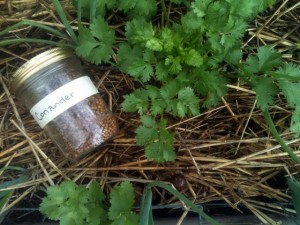 - Home grown coriander seeds with its offspring, a clump of cilantro.
A favorite seasoning of tropical cuisines ought to grow happily in summer but Cilantro just doesn’t. It much prefers the cold. How can an herb featured in Mexican and Southeast Asian dishes have such an aversion to heat? I ponder this mystery each year as tomato season approaches and we are challenged to ensure a steady supply of that distinctive, love-it-or-hate-it flavor for our summer salsas and salads.
Cilantro, the Mexican name for the leaves of the coriander plant, is related to parsley, and like its cousin, grows best in chilly temperatures. But even more than parsley, I’ve found cilantro to be a super-hardy crop for over-wintering. What a surprise!
Unlike parsley, which will produce juicy leaves for a whole season before going to seed the second year, cilantro is prone to bolting at the first sign of heat or stress. Cool temperatures keep cilantro plants in the leaf stage for a prolonged period of harvest.  But in summer the plant barely emerges before shifting its energy from making leaves to flowering, eventually producing the round, papery-skinned coriander seeds we all know from the spice cabinet.
Given that challenge, here are my strategies for keeping a steady supply of cilantro flavor all summer.
1. Keep planting all season. Find moist, shady nooks and crannies to plant cilantro seeds – behind a bean pole or under the broccoli plants – every week or two. The cilantro plant isn’t very large and has a narrow, edible tap root that won’t compete much with other plants so it can co-exist easily with most other crops. Where there’s room, I allow the plant to flower and produce seed, ensuring a steady supply of seeds for future planting. The seeds take a long time to germinate so its easy to forget where they’ve been planted but it’s always fun to discover the leaves just when you need them.
2. Use the green seeds. I’ll use any parts of the cilantro plant, leaves, flowers or roots that are still tender and fragrant — especially the juicy, newly formed seeds. Before the seeds have turned brown and dry, they have a smooth, green skin and smashed with the side of knife, release a lot of great cilantro flavor.  The crunchy little balls of spice are nice for nibbling in the garden too.
3. Freeze surplus leaves in spring. Cilantro planted as soon as the ground thaws in early spring will produce loads leaves — more that you can use. These can be washed, roughly chopped and frozen as-is. When salsa season comes around, the frozen leaves can be rinsed quickly, further chopped and added to dishes with good results.
 If anyone has other strategies for successful cilantro harvests in summer, do tell.
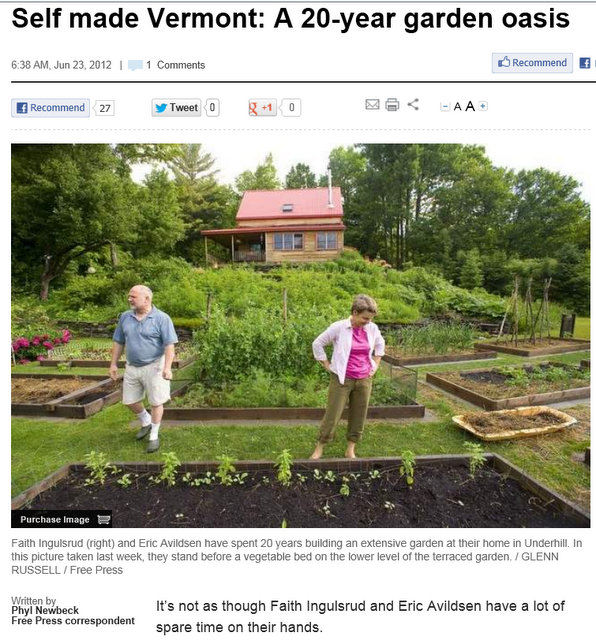
 For shy people, finding ourselves prominently displayed in a newspaper can be unnerving. But Phyl Newbeck’s story on our evolving garden in the DYI section of the Burlington Free Press on June 26, 2012, treated us gently and gave us a chance to share a bit of what we’ve learned over the years.  Here are some additional comments and clarifications from the gardener. For shy people, finding ourselves prominently displayed in a newspaper can be unnerving. But Phyl Newbeck’s story on our evolving garden in the DYI section of the Burlington Free Press on June 26, 2012, treated us gently and gave us a chance to share a bit of what we’ve learned over the years.  Here are some additional comments and clarifications from the gardener.
… <she> starts perusing seed catalogs in January to come up with a blueprint for the garden. The beds are rotated annually and at this juncture the couple has more than 100 species in the garden.
While I begin work on my seed order in January, the rotation plan is done by fall before the garlic is planted. Much of the garden prep for the coming year can then take place before winter and enabling the overwintering of cold hardy crops as well as super-early planting. In summer, I increasingly plant polycutures in  my raised beds, mixing a variety of crops, so while a strict rotation isn’t necessary, to deter the diseases that plague tomatoes in our climate, I make sure 3-years have gone by before I plant any of that family (potatoes, peppers, eggplants) in each bed.
 Daisy, Brownwyn and Earl Gray -- ducks who eat slugs and convert them to eggs. Slug patrol is performed by a trio of geese who also provide the couple with eggs.
Indian Runner ducks do our slug control — they are much smaller and easier to handle than geese! Daisy, the matron, leads her followers – the two we kept from the ducklings raised last summer.  Their siblings went to live at Tom and Ann’s duck-heaven in Jericho where the flock is guarded by an enormous goose, aptly named King.
The couple tries to avoid growing surplus, planting only enough for their needs and what can be stored in the root cellar.
We grow enough surplus to share but prefer not to spend time on food preservation. Instead we aim to grow a little of a lot of different crops so we have a variety of seasonal selections at all times and by extending the season on both ends, we can ensure fresh harvests for as long as possible. For a few, high value items like raspberry jam and basil pesto, we deem the time spent in the kitchen to be worthwhile.
In the photo gallery, the last photo depits my “hardy” fig plant. This variety, Celeste, isn’t necessarily any hardier than any others but we store the potted plant in our root cellar during the coldest winter months. I welcome any input that other Z4 gardeners can offer on growing figs and am happy to swap cuttings. Once I figure out how to coax more than 2-3 figs from each plant, I will be sure to report on it here!
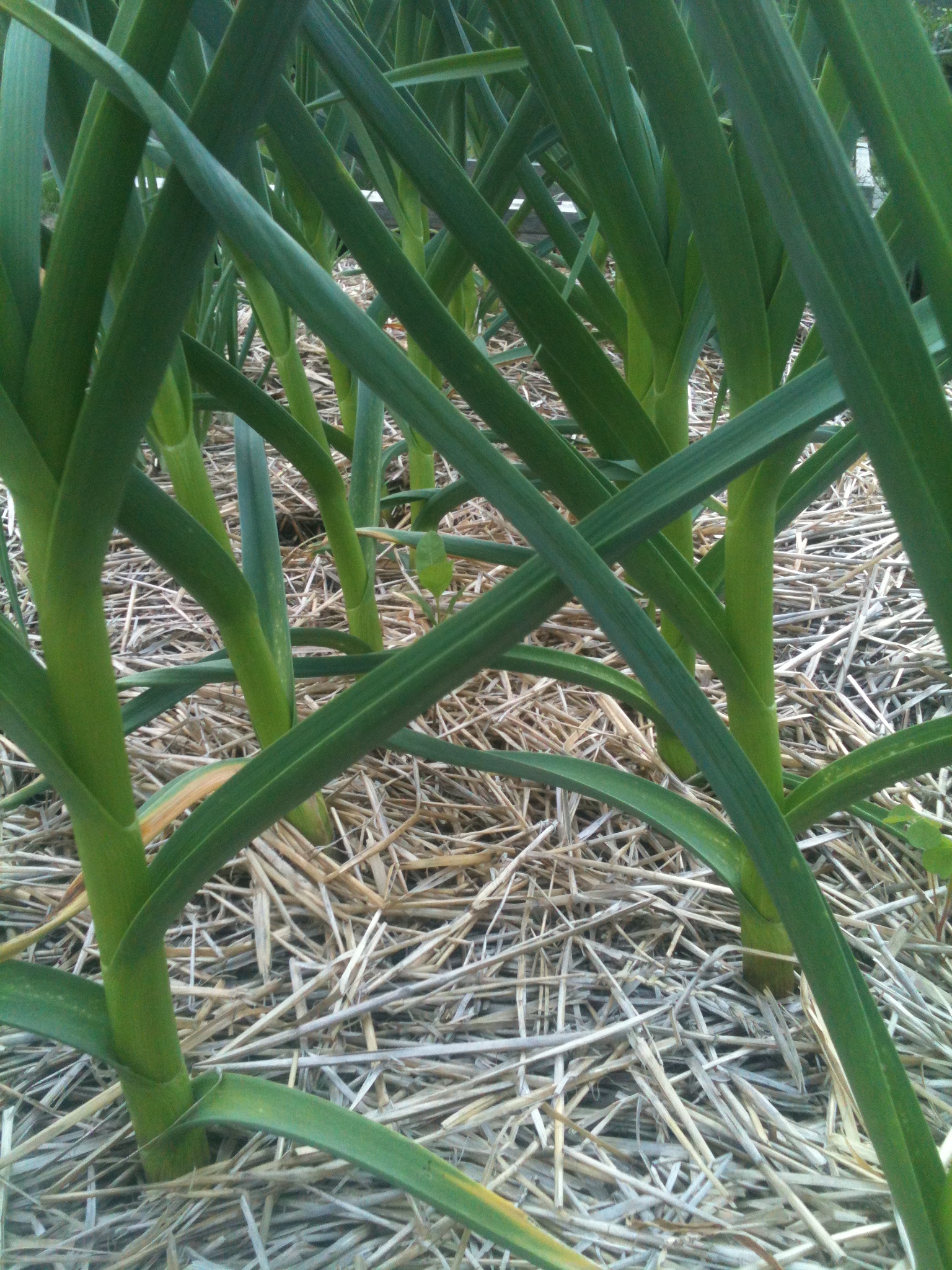
 Garlic recovered from its weather-beaten start and grows strong and healthy. Somehow the mild winter and abnormally early spring of 2012, while extremely pleasant, caused a severe case of writer’s block. Perhaps welcoming the end of the world with a lovely brunch on the deck in March (to paraphrase Peter Segal) created too much cognitive dissonance for my feeble faculties.
Now with the great unfurling of green throughout the northern hemisphere nearly complete (a good 2 weeks earlier than normal here –whatever normal is anymore) the super power of all that surging chlorophyll finally broke through the funk. I resolve to write and post on a regular basis once again.
In January, the USDA issued a new plant hardiness zone map. Considered more accurate than the previous version issued in 1990, it incorporates data from the last two decades. Thanks to the availability of this higher level of detail, it now features a way to search for your zone by zip code.
Imagine my relief when our property landed in Zone 4. No need to change the name of this blog yet!
But with the record-breaking warmth experienced lately, could the new map be out of date already? The new zone map suggests we have shifted from the slightly colder Zone 4a (average low temperatures of minus 30-35 degrees F) to Zone 4b (minus 30-25 degrees F). It’s hard to pinpoint our location on the 1990 zone hardiness map as it is too coarse with no zip code feature for more precise ID, but based on my gardening records when we moved here in 1990,the winter conditions at that time were better described as Zone 4b.
From the lack of prolonged periods of sub-zero temperatures during the last several winters and increasing rarity of even brief dips into the double digits below zero, I suspect our local climate has already shifted decisively into Zone 5. Plants reportedly unsuited to Zone 4, like crocosmia and culinary thyme, now overwinter without protection. Lavender planted in the early 90′s next to a south-facing stone wall, sulked for more than a decade but now flourishes as do the new plants, placed in more exposed locations.
Cold hardiness has implications beyond surviving average cold temperatures, as we learned from the ups and downs of this past, unseasonably warm winter. Day lily shoots, those tough little spikes of pale green that announce the start of spring, emerged during the uncanny week of summer temperatures in mid March, growing fast and leggy. Bitterly cold temperatures then followed with a whoosh of freezing winds. Those normally hardy plants that push up as soon as the ground thaws were caught unprepared and their fleshy growth unaccustomed to freezing, withered in the icy blast. Besides the day lilies, the deep cold damaged the just-emerging garlic leaves and decimated the celery-flavored lovage shoots that normally season our delicious duck eggs for brunches on chilly spring weekends.
All have now recovered and flourish,  no permanent damage done. We can only hope to do as well as we navigate the uncharted climate zones ahead.
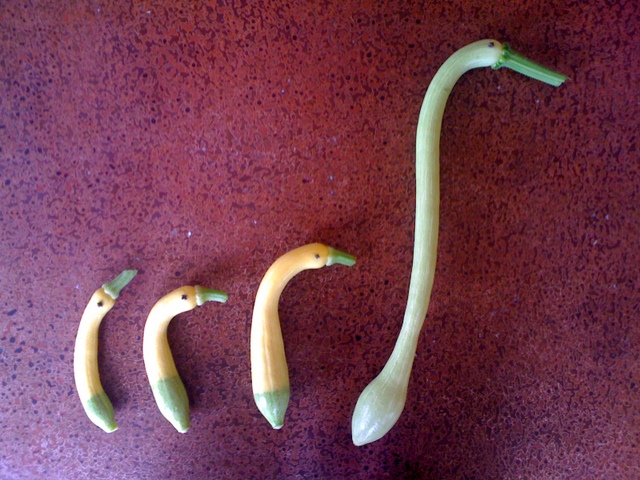 Inspired by Daisy and her flock, the Tromboncino posed as the mother duck and the Zephr zuccs as the ducklings. Ready for a change from my usual selection of zucchini varieties last year (Zephyr and Costata Romanesca), I was drawn to the description of a vining form requiring a sturdy trellis for its rampant growth. It was Zucchetta Rampicante, otherwise known as Tromboncino for the huge, fruits that form, reminiscent of brass instruments when left un-harvested. Both FEDCO and Pine Tree Seeds, two of my favorite seed companies, carry the seed.
Since one of the plants on my heavy-duty grape trellis died the year before, I decided to try the tromboncino in its place. As advertised, the vines grew like crazy, climbing up to meet the grape vines overhead and fruiting prolifically in July and again in September.
These elongated zucchinis hang elegantly from the vines and as described in the FEDCO catalogue, they are “tender, mild, sweet and nutty when harvested as summer squash at 8-12.†FEDCO also indicates that any fruit that grows beyond that stage can be baked as winter squash.
I didn’t mean to grow a fully mature Tromboncino, but as the leaves withered in early October, there at the top of the trellis was a magnificent specimen. Very photogenic. I can’t wait to see what dramatic characters will arrive with the next season’s planting of Tromboncino.
 Still life - Seated Tromboncino in fall foliage.
 Newly re-designed hoop house. If winter had arrived in November, as it often has in the past, we’d have been unprepared, crops left un-harvested and poorly protected and the detritus of our not-so-neat outdoor existence, ready to be lost under the snow. But nature was kind this year, bestowing a deliciously pleasant November with short, golden days of low-slung sunlight, brightening the browns and greys of the normally dismal and dripping stick-season. So we indulged in puttering, finishing the season’s tasks without urgency.
Now with the darkest days at hand and the arrival of sub-freezing temperatures, winter is welcome to bring it’s cleansing cold and insulating blanket of snow. Clear skies earlier this week brought temperatures close to zero degrees F. In the hoop house the kale, mache, lettuce, parsley and other hardy greens, draped with insulating fabric row covers, kept at a reasonable 27 degrees – a temperature that those hardy plants should be able to handle without stress. The newly re-built root cellar is holding steady at about 40 degrees – a little too warm for good storage – but is likely to drop into the optimal mid-30s as the winter cold settles in.
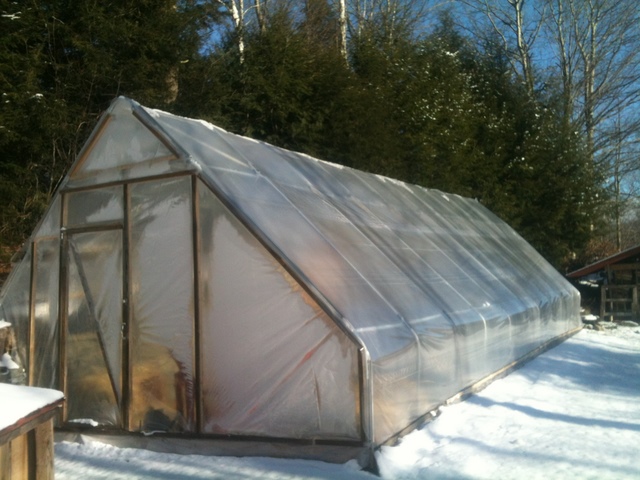
Learning from the collapse of our hoop house in the great March snowstorm of 2011, we redesigned the structure this fall, giving it a higher, more sharply-angled profile with better bracing. The hope is that it will now shed snow more effectively so the weight of another unexpectedly heavy snow fall won’t be a problem.
 Inside the hoop house before the row covers went on, the new sitting area at the far end. We also indulged ourselves by extending the length of the hoop house another 4-5 feet to make a little sitting space on the far end. Now on sunny winter days we have a comfortable place to rest and for winter picnics. Just seeing the Adirondack chairs there, makes me feel happy. As I’ve noted before, the mental health benefits of having a hoop house in a climate of long winters, is probably it’s greatest asset.
In the main garden, a light coating of snow covers the bed where a 6-12″ layer of straw is kept dry with a tarp. This insulates carrots stored in the ground right where they grew, preventing the ground from freezing. Because it requires so little work, this in-ground method for storing carrots is my favorite, but it should be avoided in years when rodent populations are exceptionally high.
There’s nothing like the pleasure of digging through the snow and rolling back the tarp to fork up a brilliantly orange carrot, the smell of live, black earth hitting the nose when everything around is frozen. I also love the the sharp crack a freshly harvested winter carrot when it’s cut — the sweet crunchiness can’t be beat
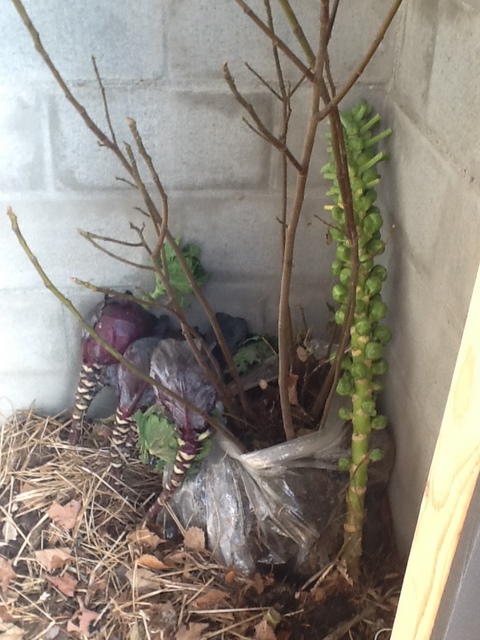
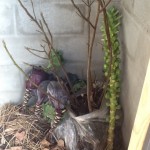 Cabbages, Brussels sprouts and a fig tree in the root cellar. Root cellar crops also offer the same satisfying crack of freshness when storage conditions are optimal. Cabbage plants can be pulled up by the roots and placed on the dirt floor of the root cellar. With a little mulch over the roots and an occasional bucket of water sloshed around to keep the roots moist, these vegetables will keep for months in excellent condition. Even if the outer layer of leaves blacken, the inner leaves remain crisp and delicious.
Root crops are packed in buckets and plastic containers, layered with wet wood chips. I like wood chips better than other recommended media like sand or peat moss because the wood chips are readily available, light weight, and keep the roots moist (to maintain freshness) but aerated (to prevent rot).
Our root cellar is built into a slope and integrated into the retaining wall on the north side of our hoop house. This enables easy, snow-free access in the winter. The original interior walls of the root cellar were built with hemlock boards but after about ten years the wood rotted and it finally fell apart. Eric rebuilt the cellar this summer with concrete block walls and a new, better insulated door that prevents heat from penetrating the necessary chill of the root cellar when the hoop house heats up on a sunny day. So far, all these new winter systems are performing well.
Here’s to continued learning and improving!  Best wishes for home-grown success to you and yours in 2012.
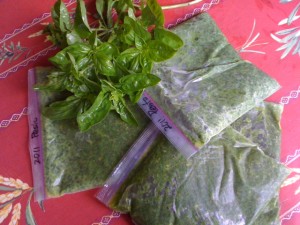 Fresh basil with bags of frozen pesto Basil, that indispensible warm-weather herb and best friend of tomatoes has been a gardener’s favorite for years. Yet during my first 25 years, basil was no more than a jar of gray, flavorless flakes in the spice cabinet – a far cry from the verdant and evocatively fragrant summer staple we know as basil today.  Basil withers at any hint of frost so as the days shorten and temperatures start to dip in September, the urgency increases to make pesto and freeze it for the precious fresh-from-the-garden taste in winter.
Back in the late 1970’s, Eric hitch-hiked to San Francisco where a food-savvy friend introduced him to basil pesto at an Italian diner. He returned full of enthusiasm for this amazingly simple, radically different and deliciously addictive pasta sauce. At that time, we’d never heard of fresh basil and it wasn’t easily available commercially – at least not at the places we shopped. So he tried making it for us using not-so-fresh spinach and parsley along with some dusty dried basil. Needless to say, we were not impressed with this new dish!
Within a few years of that introduction, basil pesto had become a fixture in trendy restaurants and sweet basil found a permanent place in home and market gardens. It’s hard to believe that before then, summer could come and go without the taste and smell of fresh basil! I have since grown, harvested and made basil pesto for freezing every year, aiming for at least dozen batches, one for each month of the year. Five or six plants started indoors in March and planted out in June, provide plenty of leaves for our household.
Having only a refrigerator freezer, I store each batch of pesto in a freezer bag and flatten it when freezing it to conserve space. I find this much more convenient than the better-known method of freezing pesto in ice cube trays. If you want just a little pesto, you can easily break off a corner of the frozen pesto from the bag and leave the rest in the freezer. If not using a whole batch for a meal, we often transfer the pesto after it thaws to a glass jar, where tightly sealed, it keeps well in the fridge for weeks adding pizazz to sandwiches, soups, salads and sauces.
For years we made pesto using the normal recipe with all raw ingredients. While it tasted perfectly good, if not used immediately, the pesto would turn dark around the edges – not very attractive. Cut edges of basil leaves oxidize and turn black and frozen pesto loses its vivid greenness.  (Finger tips blacken when processing a lot of basil too.)
Thanks to Eric’s penchant for watching cooking shows, we discovered a surprising way to avoid the oxidizing effect and preserve the rich green color of pesto for the winter table. By blanching the basil leaves! Here’s a recipe we’ve adapted from the execellent and accessible Italian recipes of Michael Chiarello. 4 cups packed fresh basil leaves
1 medium clove of garlic
1 teaspoon sea salt
1 cup olive oil (half of that extra virgin)
If freezing the pesto, then just prepare the ingredients above. If making a pasta sauce immediately, then add a few tablespoons of nuts and a half cup of grated Parmesan cheese.
Prepare a large pot of boiling water (unsalted) for blanching and an ice water bath in a large bowl or sink.
Drop the basil leaves into the boiling water and stir for about 15 seconds. Remove and shake off excess hot water then plunge leaves into the cold water, stirring to cool the leaves as fast as possible.
Gather up the chilled leaves in your hands and squeeze as much of the water out as you can. Roughly chop the leaves and blend with oil,  garlic and salt until oil turns green.
Blanching might sound fussy and time consuming but I find it takes less effort than processing the leaves raw. I always washed and removed the water in a salad spinner anyway. That took just about the same amount of time as blanching and somehow seemed more tedious.
When making multiple batches of pesto (3-4 batches can be made without it being a major chore), I blanch all the leaves first, ending up with a fist-sized pile of limp basil leaves from each 4 cup batch. This saves time and also makes it possible to take a break from the kitchen or even refrigerate the blanched leaves in a sealed container for another day before processing and freezing the pesto.
The Chiarello recipe calls for regular (non-virgin) olive oil, under the theory that extra-virgin will overwhelm the flavor of the basil. That certainly lowers the cost of making pesto and keeps the pesto lighter. But I  prefer using half extra-virgin for added richness.  Try this pesto with some newly-dug baby potatoes for a lip-smackingly delicious pesto potato salad!
 Mixed runner ducklings following Daisy, ten days after hatching. One day in early June, Daisy and Violet Duck found themselves free outside their rolling safety cage as their careless people rushed off to work. Normally they stayed out to forage only when the people were home. At night and any time they were left alone, they were put into their pen where they could enjoy fresh air, water and a new patch of grass every day without danger from the many predators salivating at the thought of a juicy duck.
When the careless people returned that evening, Violet was gone. A prominently displayed calling card from M. Fox (scat) with a clump of Violet’s feathers next to it told the sad but all too familiar story. Violet had been a timid little duck but a good side-kick to the older and more outgoing Daisy and they had contentedly eaten slugs and grubs, laid eggs and entertained the people for four years without incident.
Now Daisy needed a companion. The trauma had stopped her egg production but she still acted “broody, ” wanting to nest. So the people put a smooth, egg-shaped stone into her nest and it immediately became her reason to live. She diligently sat on that egg day and night, barely eating and drinking. Once a day she could be coaxed off the nest to run around, poop, quack and preen, but within 15 minutes was always back on her nest, meditatively keeping the stone warm and toasty.
 Daisy resting and watching the eggs hatch. After trying unsuccessfully to find a suitable companion, the people learned they could mail-order fertilized eggs from eFowl.com. A few days later Daisy went out for her daily ablutions and when she returned to the nest, instead of a single granite egg there were 12 real ones! She hesitated and turned away as though she would abandon them, but a heartbeat later resolutely stepped into the nest to begin her new life as a mother.
And what a great mother she’s been! Her people were nervous about what to expect and how to prepare for the hatchlings. The books on duck care, stressed that Indian Runners were not among the breeds with good mothering instincts. Did that mean she couldn’t be trusted to properly care for the little ones? Even the normally chatty Internet was silent about how to compensate if a duck mother was deficient in doing her job.
In retrospect the people realized that the lack of information was testiment to how little humans are needed when mother ducks are in charge.  Even Indian Runner moms know just what to do.
First evidence of maternal competence came when the eggs arrived. To make sure the eggs would be turned periodically, the people marked each egg with an X and O on opposite sides. Sure enough, she was turning them every few hours.
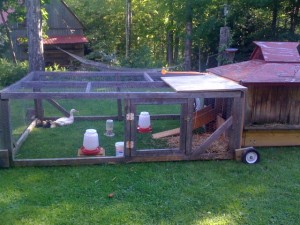 Rolling duck pen with attached house -- an evolving system for duck safety and happiness. When the hatching began 27 days later, she squatted over the little fuzz balls as they emerged, keeping them warm without crushing those that had hatched and maintaining heat for those still in their shells. Quite an athletic feat! Nine out of the twelve hatched – fuzzy little Runners ducks in a mix of colors.
By day 29 it was obvious that the remaining 3 eggs were not viable. They began to dry out and the previouslywell-maintained nest was flattened – tromped down by duckling stampedes. Daisy did not object when the dead eggs were removed.
A week later, Daisy demanded to leave the now-claustrophobic duck house so she could lead the flock outside into the caged pen. The ducklings were elated, racing around and nibbling on the grass. Thanks to the recent hot spell with ambient temps averaging in the high 70’s, Daisy was finally able to relax, and not work so hard to keep them warm. Each day their fuzz has increasingly been replaced by warmer proto-feathers. They are now comfortably handling nights in the 50’s without stress.
Daisy’s work as a mom is nearly complete. She watches them indulgently from a short distance, a distinct look of pride on her little ducky face.
|
|